Seismotectonic studies in the Upper Rhine Graben
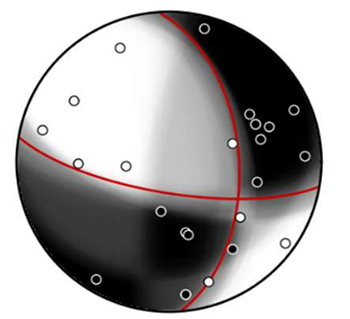
In a recent Bachelor thesis, we estimated earthquake focal mechanisms for a number of earthquakes that occurred in 2020 in the Upper Rhine Graben and its wider region. Earthquake focal mechanisms provide information about the earthquake’s rupture mechanism and can serve as indicators of the stress directions in the crust. We used seismograms from regional public stations , as well as observations from seismic stations operated by our institute. Where possible, the arrival times of P- and S-waves were determined from the seismograms recorded at our stations, as well as the initial directions of ground motion – known as polarities – of the incoming P-waves. From this, the radiation characteristics and directions of the shear failures can be inferred. The findings of this thesis provide important information about the current tectonics of our region.

We were able to estimate robustly the focal mechanisms for twelve earthquakes in 2020. These included the earthquake near Todtnau on the afternoon of 24 February 2020. Despite its considerable depth of around 20 km, this magnitude 2.5 earthquake was clearly felt by many people in the area. The mechanism shows a significant strike-slip component, but also a normal component, suggesting that a rupture occurred within an altered stress field along a long-standing fault zone.
Modeling of the Volcanic Activity of the November 2025 Hayli Gubbi Eruption
In November 2025, news outlets around the world reported on the unexpected eruption of the Hayli Gubbi volcano in Ethiopia. While the entire region surrounding this volcano is strongly influenced by volcanism along the Afar Rift, no eruption had ever been observed at Hayli Gubbi until then. In a bachelor thesis, we investigated the event. Hayli Gubbi volcano is located not far from the highly active Erta Ale volcano. Erta Ale had already shown increased activity in July 2025, and a large fissure intrusion was observed during that time. No activity was found at Hayli Gubbi, however.
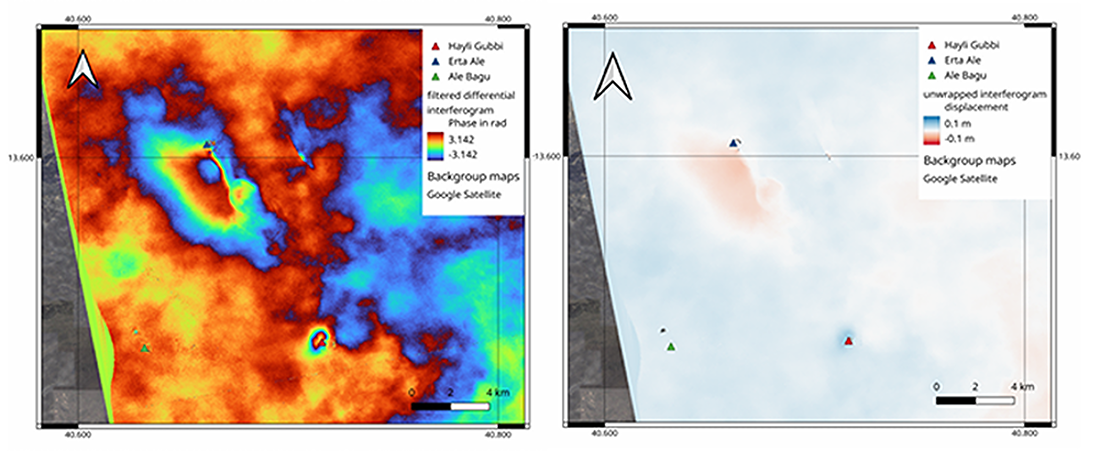
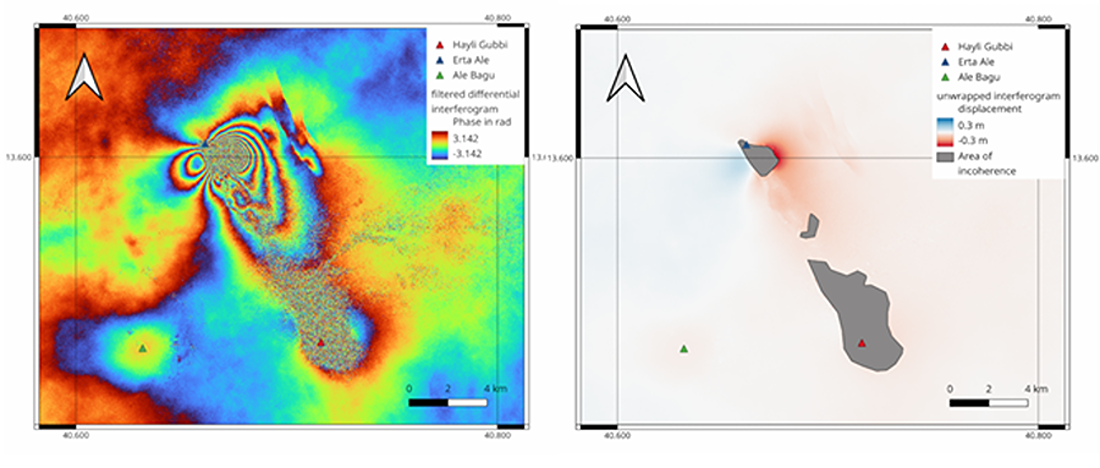
Using interferometric radar satellite imagery, we observed that prior to the Hayli Gubbi eruption, the ground around the Erta Ale volcano subsided, while the ground around Hayli Gubbi showed uplift (top figure). The subsequent eruption of Hayli Gubbi was accompanied by ground subsidence at both volcanoes and a fissure intrusion between them (lower figure). We therefore suspect that this is due to magma movements between the two volcanoes within a connected volcanic system.
By modeling magma sources and fissure intrusions, we were able to substantiate this hypothesis.